 YOUDA COMPOSITE
If you have shopped for a folding knife or a fixed-blade survival knife in recent years, you have almost certainly come across G10 handles. This material appears on everything from budget-friendly EDC knives to high-end tactical blades. But what exactly is G10, and why do so many knife makers choose it?
In short, G10 is a high-pressure fiberglass laminate. It is incredibly strong, lightweight, and resistant to moisture, chemicals, and temperature changes. These qualities make it one of the most practical handle materials available today.
This article explains what G10 is made of, walks through its key properties, compares it with other common handle materials, and covers its main applications in the knife world.
What Is G10 Material?
G10 is a composite material made from layers of woven fiberglass cloth bonded with epoxy resin. The layers are stacked, saturated with resin, and then compressed under high heat (around 150°C / 300°F) and pressure. The result is a dense, rigid sheet with no internal voids.
The name “G10” comes from the National Electrical Manufacturers Association (NEMA) grading system. The “G” stands for glass fiber reinforcement, and “10” refers to the specific resin system and performance grade. The material was first developed in the 1950s for electrical insulation, especially for printed circuit boards. Knife makers began using it in the 1980s, and it has been a staple of the industry ever since.
G10 vs. FR4: What Is the Difference?
FR4 is often mentioned alongside G10. Both use fiberglass cloth and epoxy resin. The difference is that FR4 contains a brominated flame-retardant additive. For knife handles, this distinction rarely matters. However, G10 typically offers slightly higher flexural strength (75,000 psi vs. 60,000 psi), which is why most knife makers prefer the non-flame-retardant version.
Key Properties of G10
G10 stands out because of its balanced combination of mechanical and environmental properties. Here are the numbers that matter:
Property | Value |
Tensile Strength (lengthwise) | ~40,000 psi |
Tensile Strength (crosswise) | ~35,000 psi |
Compressive Strength | ~65,000 psi |
Flexural Strength | 55,000–75,000 psi |
Specific Gravity (density) | 1.80–1.85 |
Rockwell Hardness (M scale) | 110 |
Moisture Absorption | Near zero |
High Strength-to-Weight Ratio
G10 has a specific gravity of approximately 1.80 to 1.85. For comparison, 6061 aluminum sits at 2.70, and titanium at 4.51. This means a G10-handled knife is noticeably lighter than one with metal handles, yet the material is strong enough to withstand heavy use without deforming.
Moisture and Chemical Resistance
G10 is non-porous. It does not absorb water, sweat, oils, or most chemicals. A G10 handle will not swell in humid weather, crack from drying out, or develop odors from repeated handling. This makes it ideal for outdoor knives, fishing knives, and kitchen knives.
Dimensional Stability
G10 does not expand or contract under normal temperature and humidity swings. The handle scales will stay tightly fitted to the tang and liners regardless of the season. This prevents gaps that could allow moisture to reach internal hardware.
Impact Resistance
The woven glass fiber structure distributes impact force across the laminate layers rather than concentrating it at one point. A G10 handle can survive drops onto concrete that would crack bone, chip wood, or dent aluminum.
Electrical Insulation
Because G10 was originally designed for electrical applications, it is an excellent insulator. This is a secondary benefit for most knife users, but it adds a layer of safety in environments where electrical hazards may exist.
How G10 Compares to Other Handle Materials
G10 vs. Micarta
Micarta is made using a similar process but uses fabric (linen, canvas, or paper) instead of fiberglass cloth. Both materials are durable, but there are key differences:
Hardness: G10 scores 110 on the Rockwell M scale, while Micarta scores around 105.
Moisture resistance: G10 absorbs almost no moisture. Micarta absorbs a small amount and may feel grippier when wet on untextured surfaces.
Strength: G10 rates higher in tensile, compressive, and flexural strength.
Feel: Micarta feels warmer in the hand and develops a patina over time. G10 maintains its original appearance.
For hard-use knives exposed to moisture, G10 is generally the better choice. For users who prefer a more natural feel, Micarta has its appeal.
G10 vs. Carbon Fiber
Carbon fiber replaces glass fibers with carbon strands. The result is a stiffer, lighter, and more expensive material.
Weight: Carbon fiber is lighter (specific gravity ~1.55 vs. G10’s ~1.80).
Strength: Carbon fiber has higher flexural strength but is more brittle. It can crack or chip on hard impacts that G10 would absorb.
Cost: Carbon fiber is significantly more expensive to produce and machine.
Aesthetics: Carbon fiber has a distinctive woven pattern that many users find attractive. G10 offers a wider range of solid colors and layered patterns.
For a knife that will see heavy daily use and occasional drops, G10 provides a more practical balance of strength, impact resistance, and cost.
G10 vs. Titanium
Titanium handles are strong, corrosion-resistant, and have a premium feel. However, they have trade-offs:
Weight: Titanium is much heavier (specific gravity 4.51 vs. 1.80 for G10).
Temperature: Titanium conducts heat and cold readily. A titanium handle left in a cold vehicle will feel freezing in the hand. G10 does not transfer temperature the same way.
Cost: Titanium handles add considerable cost to a knife.
Wear: Titanium shows scratches more easily. G10 hides surface wear well within its textured finish.
G10 vs. Wood
Wood has been used for knife handles for centuries and offers natural beauty. But it has real performance limitations:
Wood expands and contracts with humidity, which can loosen the handle over time.
Wood requires regular oiling and protection from moisture.
Wood can crack, chip, or warp under impact or temperature changes.
G10 requires none of this maintenance. For a working knife that must perform reliably in all conditions, G10 is the more dependable choice.
Benefits of G10 Knife Handles
- Exceptional Durability
A G10 handle will maintain its structural integrity through years of use. It resists cracking, chipping, and deformation even under hard use. This is why military, law enforcement, and outdoor professionals frequently choose G10-handled knives.
- Excellent Grip
Knife makers machine textures into G10 scales—common patterns include cross-hatching, stippling, and linear grooves. When properly textured, G10 provides secure grip in wet, muddy, or greasy conditions. This is critical for safety and control.
- Low Maintenance
G10 requires almost no upkeep. Soap and water are enough to clean it. The material does not absorb stains, odors, or oils. It does not need oiling, conditioning, or sealing. This is a significant advantage over natural materials like wood or bone.
- Wide Range of Colors
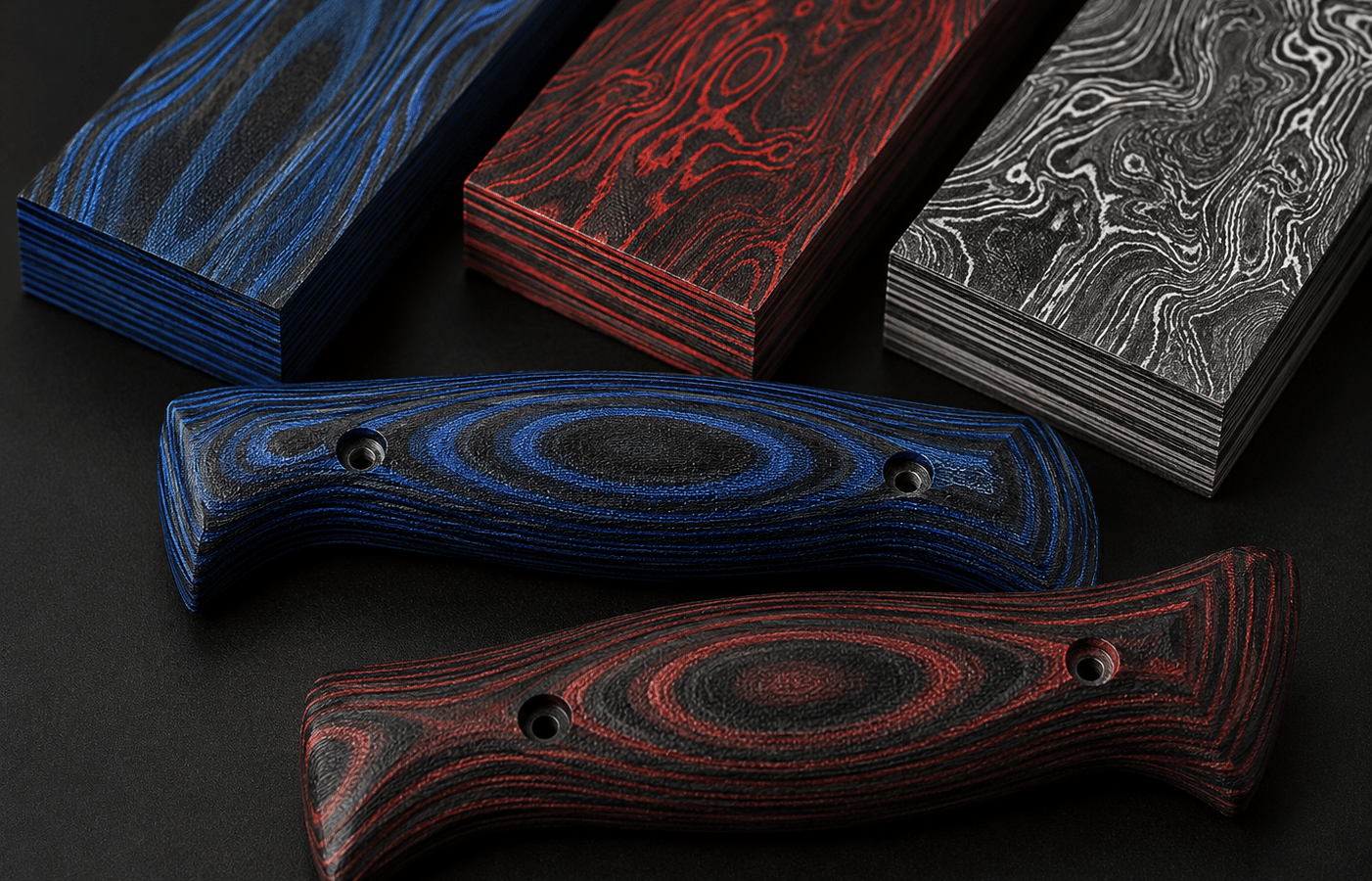
G10’s natural color is a translucent greenish hue, but modern production adds pigment to the resin before curing. This produces sheets in black, gray, tan, red, blue, orange, and many other colors. Layered G10 stacks different colored sheets to create visible patterns. The color runs through the full thickness of the material, so it will not fade or wear off.
- Affordable
Compared to titanium or carbon fiber, G10 is cost-effective to produce and machine. This allows knife makers to offer high-performance handles at mid-range prices.
Common Applications
Folding Knives
The majority of mid-range and production folding knives ship with G10 handles. A knife carried in a pocket every day encounters sweat, lint, temperature changes, and occasional drops. G10 handles all of these without degradation.
Fixed-Blade Tactical and Survival Knives
Fixed blades used in wet, cold, or abrasive environments benefit most from G10’s properties. The material does not get slippery when wet. It does not conduct cold from the blade tang to the hand. It survives impacts that would damage other handle materials.
Kitchen Knives
G10’s non-porous surface meets hygiene standards for food preparation. It does not harbor bacteria and does not absorb food odors or liquids. Washing with soap and water is all that is needed.
Specialty Non-Metallic Blades
G10 is occasionally used to make entire non-metallic knives for specialized environments—such as secure facilities with metal detectors or areas with electrical hazards. However, G10 blades cannot hold an edge like steel and are not suitable for heavy cutting tasks.
Care and Maintenance
Caring for a G10 handle is simple:
Cleaning: Wipe with a damp cloth or wash with mild soap and water. A soft brush helps remove grime from textured surfaces.
Drying: Towel dry after exposure to water. The material itself does not absorb moisture, but metal components can corrode if left wet.
Storage: Store in a cool, dry place. Use a sheath or case to prevent accidental scratches.
Restoration: If a G10 scale gets deeply scratched, light sanding with 220-grit sandpaper followed by 400-grit will restore the texture. The color runs through the material, so sanding will not expose a different color.
Limitations of G10
No material is perfect. Here are G10’s main drawbacks:
Hardness to the touch: G10 is rigid with no “give.” Some users find it less comfortable than rubber or wood during prolonged use.
Temperature feel: While G10 does not conduct heat like metal, it can still feel cold or hot to the touch depending on the environment.
Appearance: G10 has an industrial look. It lacks the natural grain patterns and warmth of wood or bone.
Machining difficulty: The abrasive nature of G10 dulls cutting tools quickly. Machining requires carbide or diamond-tipped tools and proper dust collection.
Conclusion
G10 has earned its place as one of the most widely used knife handle materials for good reason. It combines high strength, light weight, moisture resistance, and low maintenance at a reasonable cost. It outperforms natural materials in harsh conditions and offers a practical alternative to more expensive options like titanium and carbon fiber.
Whether you need a reliable everyday carry folder, a rugged survival knife, or a low-maintenance kitchen tool, a G10 handle is a choice that will serve you well for years.