 YOUDA COMPOSITE
The blade gets most of the attention when people shop for a knife. But the handle is just as important. It determines how the knife feels in your hand, how well you can grip it in wet conditions, how much the knife weighs in your pocket, and how long it will last.
Knife handle materials fall into three broad categories: synthetics, metals, and naturals. Each category has its own strengths and weaknesses, and within each category, individual materials perform very differently.
This guide covers every major knife handle material on the market today. You will learn what each material is made of, how it performs, and which situations it suits best.
Quick Comparison Table
Material | Category | Weight | Durability | Grip (Wet) | Cost | Best For |
G10 | Synthetic | Light | Excellent | Good (textured) | $$ | EDC, tactical, outdoor |
Micarta | Synthetic | Light | Very Good | Good | $$$ | EDC, collector pieces |
Carbon Fiber | Synthetic | Very Light | High (but brittle) | Fair | $$$$ | Light EDC, show knives |
FRN / Zytel | Synthetic | Very Light | Good | Fair | $ | Budget EDC, work knives |
Titanium | Metal | Moderate | Excellent | Fair (textured) | $$$$ | Premium EDC, hard use |
Aluminum | Metal | Moderate | Good | Fair | $$ | Mid-range EDC |
Stainless Steel | Metal | Heavy | Excellent | Poor | $ | Budget knives, collector pieces |
Wood | Natural | Light | Varies | Fair | $–$$$$ | Traditional, collector knives |
Bone | Natural | Light | Moderate | Poor | $$ | Traditional pocket knives |
Leather | Natural | Light | Low | Fair | $ | Classic hunting, military |
Synthetic Materials
Synthetic materials dominate the modern knife market. They offer predictable performance, wide design flexibility, and excellent value.
G10
G10 is a high-pressure fiberglass laminate. Layers of woven fiberglass cloth are soaked in epoxy resin and cured under heat and pressure. The result is a dense, rigid, non-porous material.
Key specs:
Density: 1.80–1.85 g/cm³
Tensile strength: ~40,000 psi lengthwise, ~35,000 psi crosswise
Rockwell hardness (M scale): 110
Moisture absorption: near zero
Pros:
Extremely strong and impact-resistant
Near-zero moisture absorption—will not swell, warp, or rot
Wide range of colors and layered patterns available
Affordable compared to carbon fiber and titanium
Low maintenance—wash with soap and water
Cons:
Rigid with no “give”—some users find it less comfortable over long use
Can feel slippery when wet if not properly textured
Abrasive dust during manufacturing (not a user concern)
Best for: Everyday carry, tactical folders, survival knives, kitchen knives. The go-to choice for a do-everything handle.
For more details, read our full guide: What Is G10 Knife Handle Material?
Micarta
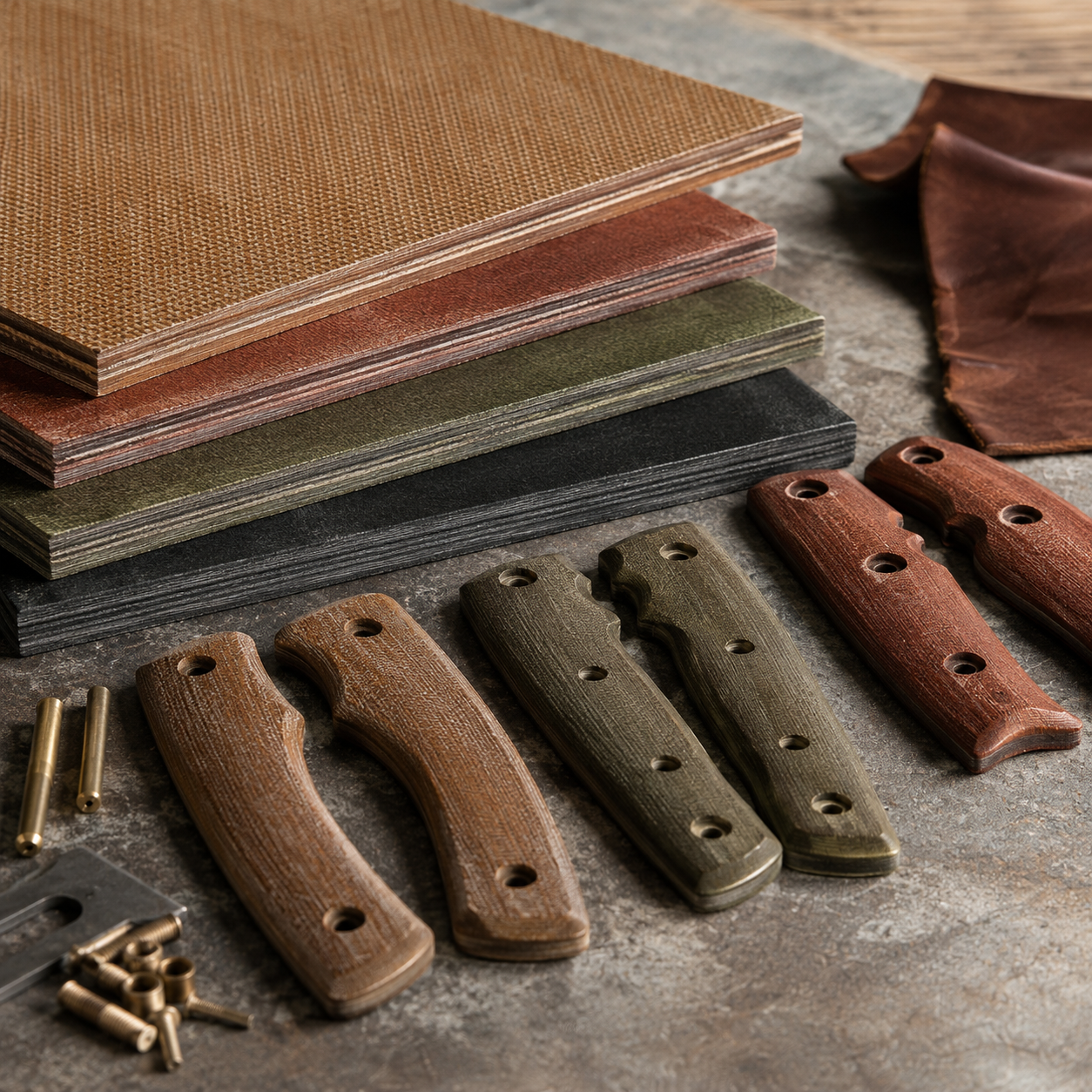
Micarta is made using the same lamination process as G10, but it uses fabric—linen, canvas, or paper—instead of fiberglass cloth. The fabric is saturated with phenolic resin and cured under heat and pressure.
Key specs:
Density: 1.30–1.40 g/cm³
Tensile strength: ~12,500 psi (linen-based)
Rockwell hardness (M scale): ~105
Moisture absorption: low to moderate
Pros:
Warm, natural feel in the hand
Develops a patina with use that many collectors value
Grippier than smooth G10 when wet (fabric texture provides traction)
Highly durable and impact-resistant
Cons:
Slightly less hard than G10
Absorbs more moisture than G10
More expensive than G10
Limited color options compared to G10
Best for: Users who want a more natural, warm feel without sacrificing durability. Popular on mid-to-high-end folders and custom knives.
For more details, read our full guide: What Is Micarta Knife Handle Material?
Carbon Fiber
Carbon fiber is made from thin strands of carbon tightly woven into fabric and set in epoxy resin. The carbon weave gives it a distinctive, high-tech appearance.
Key specs:
Density: ~1.55 g/cm³
Flexural strength: 80,000+ psi
Very high stiffness-to-weight ratio
Pros:
The lightest high-strength handle material available
Excellent stiffness and tensile strength
Distinctive woven pattern with visual depth
Moisture and chemical resistant
Cons:
Expensive—can add significant cost to a knife
Brittle—can crack or chip under sharp impact
Harder to machine than G10 or Micarta
Less grip when smooth compared to textured G10
Best for: Lightweight EDC knives where every gram counts. Show pieces where aesthetics matter. Not ideal for hard-use knives that will see drops and impacts.
For more details, read our full guide: What Is Carbon Fiber Knife Handle Material?
FRN (Fiberglass-Reinforced Nylon) / Zytel
FRN is a thermoplastic made by mixing short glass fibers into nylon. Zytel is DuPont’s brand name for FRN. The material is injection-molded into shape, making it very cost-effective for mass production.
Other names you will see include GRN (glass-reinforced nylon) and GFN (glass-filled nylon)—these are effectively the same material.
Key specs:
Density: ~1.35–1.45 g/cm³
Glass fiber reinforcement: typically 30–50%
Highly impact-resistant
Pros:
Very affordable—injection molding keeps costs low
Lightweight and strong in all directions (fibers are randomly oriented)
Zero maintenance
Can be molded with built-in texture patterns
Excellent impact resistance
Cons:
Can feel “cheap” or hollow compared to G10
Less grippy than textured G10
Surface can show wear over time
Cannot be refinished like G10
Best for: Budget to mid-range EDC knives, work knives, and high-volume production models. Spyderco is famous for getting excellent results from FRN.
Rubber and TPE (Thermoplastic Elastomer)
Rubber-like materials—including Kraton, TPE, and Santoprene—are used where maximum grip is the priority. These materials are soft, flexible, and provide friction even when wet or oily.
Pros:
Best grip of any handle material, wet or dry
Soft and comfortable in the hand
Absorbs shock and vibration
Very affordable
Cons:
Can degrade over time with UV exposure and heavy use
Attracts lint and dust
Less durable than rigid materials
Not as visually appealing
Best for: Tactical knives, diving knives, work knives used in wet or oily conditions. Often used as inlays on metal or G10 handles rather than as the entire handle.
Metal Materials
Metal handles offer maximum structural strength and a premium feel. They are heavier than synthetics but can be machined to precise tolerances.
Titanium
Titanium is the premium metal choice for knife handles. It is strong, corrosion-proof, and lighter than steel. Most knife handles use Grade 5 titanium (Ti-6Al-4V), an alloy with 6% aluminum and 4% vanadium.
Key specs:
Density: ~4.51 g/cm³
Tensile strength (Grade 5): ~130,000 psi
Fully corrosion-resistant
Pros:
Best strength-to-weight ratio of any metal
Completely rust-proof—ideal for marine environments
Feels warm to the touch (low thermal conductivity compared to other metals)
Can be anodized to produce vibrant colors
Extremely durable
Cons:
Expensive—titanium costs more to buy and machine
Heavier than G10 or carbon fiber
Prone to scratches (though they can be refinished)
Can be slippery without texturing
Best for: Premium EDC knives, hard-use folders, and knives exposed to saltwater. The Chris Reeve Sebenza and Spyderco SpydieChef are famous titanium-handled designs.
Aluminum
Aluminum handles are lighter than titanium and much more affordable. Most knife makers use T6-6061 aluminum alloy, which offers good strength and takes anodizing well.
Key specs:
Density: ~2.70 g/cm³
Tensile strength (6061-T6): ~45,000 psi
Corrosion-resistant (especially when anodized)
Pros:
Lighter than titanium
Much more affordable than titanium
Can be anodized in many colors
Strong and durable for everyday use
Good machining properties
Cons:
Feels cold in winter—aluminum conducts heat rapidly
Softer than titanium—shows dings and scratches more easily
Not as strong as titanium
Can be slippery without texturing
Best for: Mid-range EDC knives that balance weight, durability, and cost. The Benchmade 940 is a classic example.
Stainless Steel
Stainless steel handles are strong, durable, and inexpensive, but they come with a significant weight penalty.
Key specs:
Density: ~7.85–8.00 g/cm³
High tensile strength
Corrosion-resistant (grade-dependent)
Pros:
Extremely strong and durable
Very affordable
Corrosion-resistant
Can be polished to a mirror finish
Cons:
Heavy—twice the weight of titanium
Cold to the touch
Can be very slippery without texturing
Adds significant carry weight
Best for: Budget knives, traditional slipjoints, and knives where weight is not a concern. The Kershaw Leek and Spyderco Dragonfly are well-known examples.
Natural Materials
Natural materials offer warmth, beauty, and tradition that synthetics cannot fully replicate. However, they require more care and are less consistent in performance.
Wood
Wood has been used for knife handles for thousands of years. The performance depends heavily on the type of wood and how it is treated.
Common wood types:
Hardwoods: Walnut, oak, rosewood, ebony, cocobolo—dense, durable, and attractive.
Stabilized wood: Natural wood injected with polymer resin under vacuum and pressure. Much more stable and moisture-resistant than untreated wood. Common brands include Dymondwood and Pakkawood.
Softwoods: Rarely used for quality knives due to low durability.
Pros:
Natural beauty with unique grain patterns—no two handles are identical
Warm, comfortable feel in the hand
Wide variety of species and colors
Traditional and collectible
Stabilized wood offers good durability
Cons:
Untreated wood expands and contracts with humidity
Requires regular oiling and maintenance
Can crack, warp, or rot if neglected
Less impact-resistant than synthetics
Quality varies widely
Best for: Traditional pocket knives, hunting knives, and collector pieces. The Opinel and Buck 110 are iconic wood-handled knives.
Bone
Bone handles have been used since the earliest knives. Today, cow bone is the most common source, though exotic bone from giraffe, camel, or elephant is also used on high-end pieces.
Pros:
Classic, traditional appearance
Can be dyed in bright colors
Can be jigged (machined with patterns) for better grip and visual texture
Affordable
Cons:
Porous—can absorb moisture and deform
Susceptible to cracking from impact or temperature changes
Somewhat slippery even when jigged
Not suitable for hard-use or wet-condition knives
Best for: Traditional slipjoint pocket knives and collector pieces. Case and Boker are known for their bone-handled knives.
Leather
Leather handles are created by stacking leather washers on the knife tang and compressing them tightly. The handle is then shaped and polished. This is a traditional construction method seen on classic hunting and military knives.
Pros:
Classic look and feel
Comfortable in the hand
Affordable
Cons:
Absorbs moisture—can rot if not dried properly
Low structural strength
Degrades over time with heavy use
Difficult to clean
Best for: Classic hunting knives and military reproductions. The KA-BAR USMC knife is the most famous example.
Mother of Pearl
Mother of pearl comes from the inner layer of mollusk shells. It has an iridescent, shimmering appearance that makes it popular for upscale and dress knives.
Pros:
Stunning natural beauty with unique iridescence
Smooth and comfortable
Strong for a natural material
Cons:
Expensive
Can be brittle and chip under impact
Slippery
Limited to smaller handle sizes
Best for: Dress knives, gentleman’s folders, and collector pieces. Not suitable for heavy use.
How to Choose the Right Handle Material
For Everyday Carry (EDC)
Top choice: G10. It is light enough for comfortable pocket carry, strong enough to survive drops, grippy when textured, and available at reasonable prices. Titanium is the premium alternative if budget allows.
For Wet or Marine Environments
Top choice: G10 or Titanium. Both are fully waterproof and will not corrode. G10 has the edge in grip. Titanium offers unmatched corrosion resistance for saltwater exposure.
For Budget Knives
Top choice: FRN. Injection-molded FRN handles keep costs low while providing good durability and grip. Stainless steel is another affordable option if you do not mind the extra weight.
For Cold Weather Use
Top choice: G10 or Micarta. Synthetics do not conduct heat like metal. Your hand will not freeze against a G10 handle the way it will against aluminum or steel.
For Collectors and Traditionalists
Top choice: Wood or Bone. These materials offer unmatched natural beauty and tradition. Stabilized wood bridges the gap between aesthetics and performance.
For the Lightest Possible Knife
Top choice: Carbon Fiber. At ~1.55 g/cm³, it is the lightest rigid handle material. Paired with a lightweight blade, it produces knives that disappear in the pocket.
Material Weight Comparison (Lightest to Heaviest)
Material | Density (g/cm³) |
Carbon Fiber | ~1.55 |
Micarta | 1.30–1.40 |
FRN / Zytel | ~1.35–1.45 |
G10 | 1.80–1.85 |
Aluminum | ~2.70 |
Titanium | ~4.51 |
Stainless Steel | ~7.85–8.00 |
Conclusion
There is no single “best” knife handle material—the right choice depends on how and where you use your knife.
G10 is the best all-rounder: strong, light, waterproof, and affordable.
Micarta adds warmth and patina for those who want a natural feel.
Carbon fiber wins on weight and aesthetics at a higher price.
Titanium is the premium metal choice for hard use and corrosion resistance.
Aluminum and FRN deliver good performance at lower cost.
Wood and bone offer tradition and beauty for collectors and classic designs.
Think about where you will carry your knife, what conditions it will face, and how much maintenance you are willing to do. That will point you to the right material.