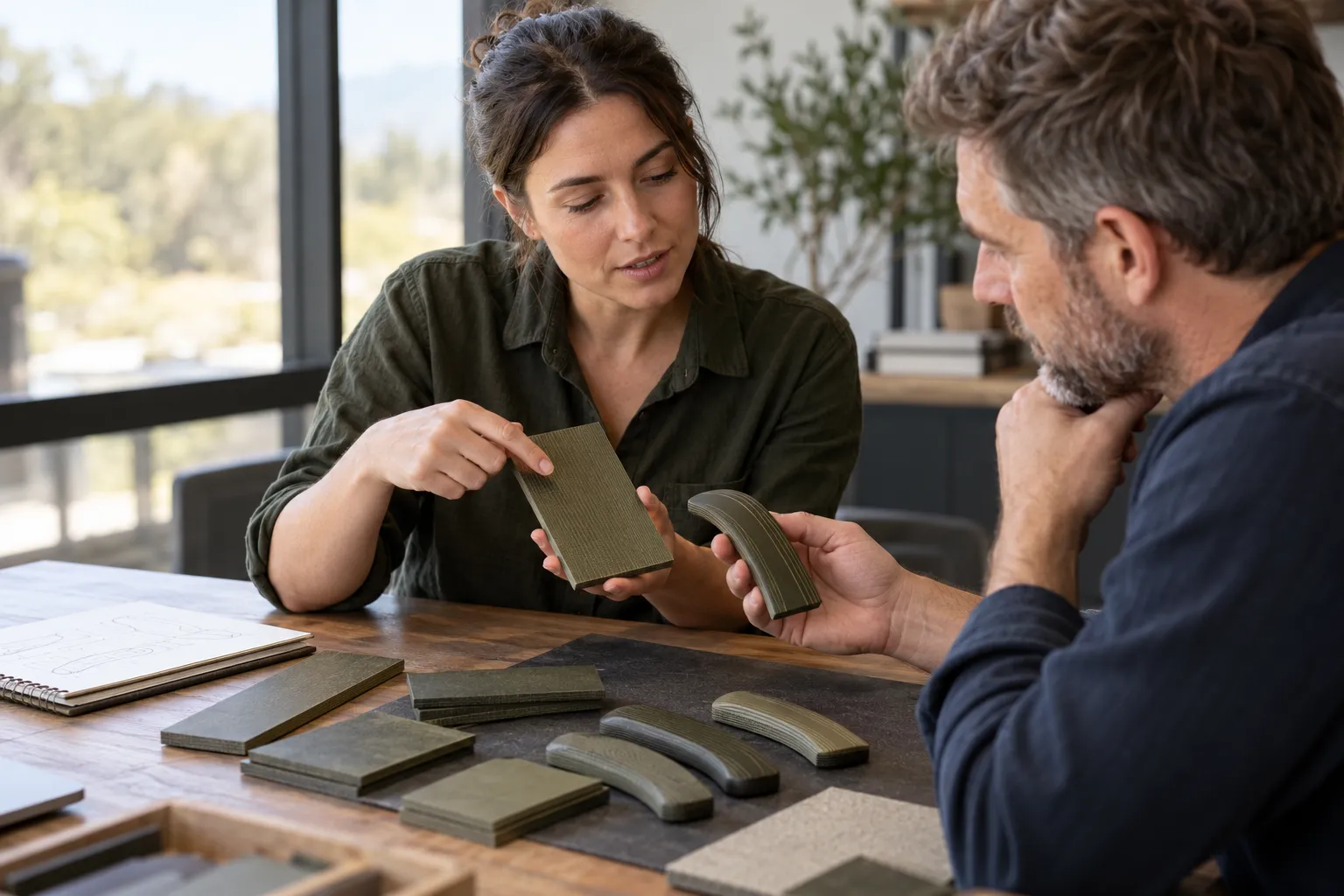
Two photographs seemed to show two colors “We approved olive green. These look brown.” The customer’s message included a photograph of finished handle scales beside an earlier sample image. The difference looked obvious on the screen. A product launch was approaching, and the customer wanted to know whether the wrong material had been supplied.In this […]
Looking beyond a single dimension when choosing a handle Two handles can share the same outline and still feel like different objects because their cross sections differ. A thin flat profile, a moderate rounded profile, and a fuller palm swell occupy the hand in different ways. Thickness also changes the object that must be carried […]
A close photograph of a Micarta handle can contain several patterns at once. There may be tiny crossing threads, broad bands around a curved edge, and repeated grooves along the face. Calling all of them cloth texture hides useful information. Some detail comes from the reinforcement, some from the way layers are exposed, and some […]
Limited-edition handle colors can refresh an established knife without changing the blade platform. They can create urgency, support collaborations and give dealers a reason to feature the model again. Yet a successful color launch requires more than an attractive sample: the name, cultural meaning, production tolerance and release quantity all influence whether the campaign builds […]
A handle that feels secure in a product photograph may behave differently with wet hands, winter gloves or prolonged use. Material matters, but no composite automatically creates good ergonomics. G10, fabric-reinforced phenolic laminate and carbon fiber must be combined with suitable geometry, texture, finish and testing for the intended task. Start With the Use Case […]
A custom handle can become one of the most recognizable parts of a knife brand. The commercial value may come from a specific layer sequence, a private color, a CNC texture, a matched carbon-fiber pattern or the way these features work together. Protecting that value requires more than sending a reference photo and asking a […]
Online buyers cannot hold a knife before ordering, so photographs become part of the product specification. When a G10 color looks different on arrival, a layered laminate appears flatter than expected, or carbon fiber does not reflect light like the listing image, the customer may describe a presentation problem as a quality problem. Better photography […]
Buying CNC-machined handle scales can remove several factory steps, but it also shifts responsibility upstream. The decision should be based on total landed and production cost, not only the quoted part price. Choose the Right Supply Format Full sheets give the buyer maximum nesting flexibility but require local cutting, dust control and inspection. Rectangular blanks […]
A handle color that sells well in one market may look overly tactical, too decorative or too conservative in another. International knife brands need cultural awareness, but not stereotypes. The best approach is to understand the signals carried by color, texture, finish and product language, then validate them with local dealers and customer data. American […]
Environmental language has become a sales tool, but vague claims can damage trust faster than silence. Calling a G10, phenolic fabric laminate or carbon-fiber handle “eco-friendly” without defining the basis invites questions that most suppliers cannot answer. European Expectations Are Becoming More Specific EU rules on empowering consumers for the green transition are aimed at […]
 YOUDA COMPOSITE