 YOUDA COMPOSITE
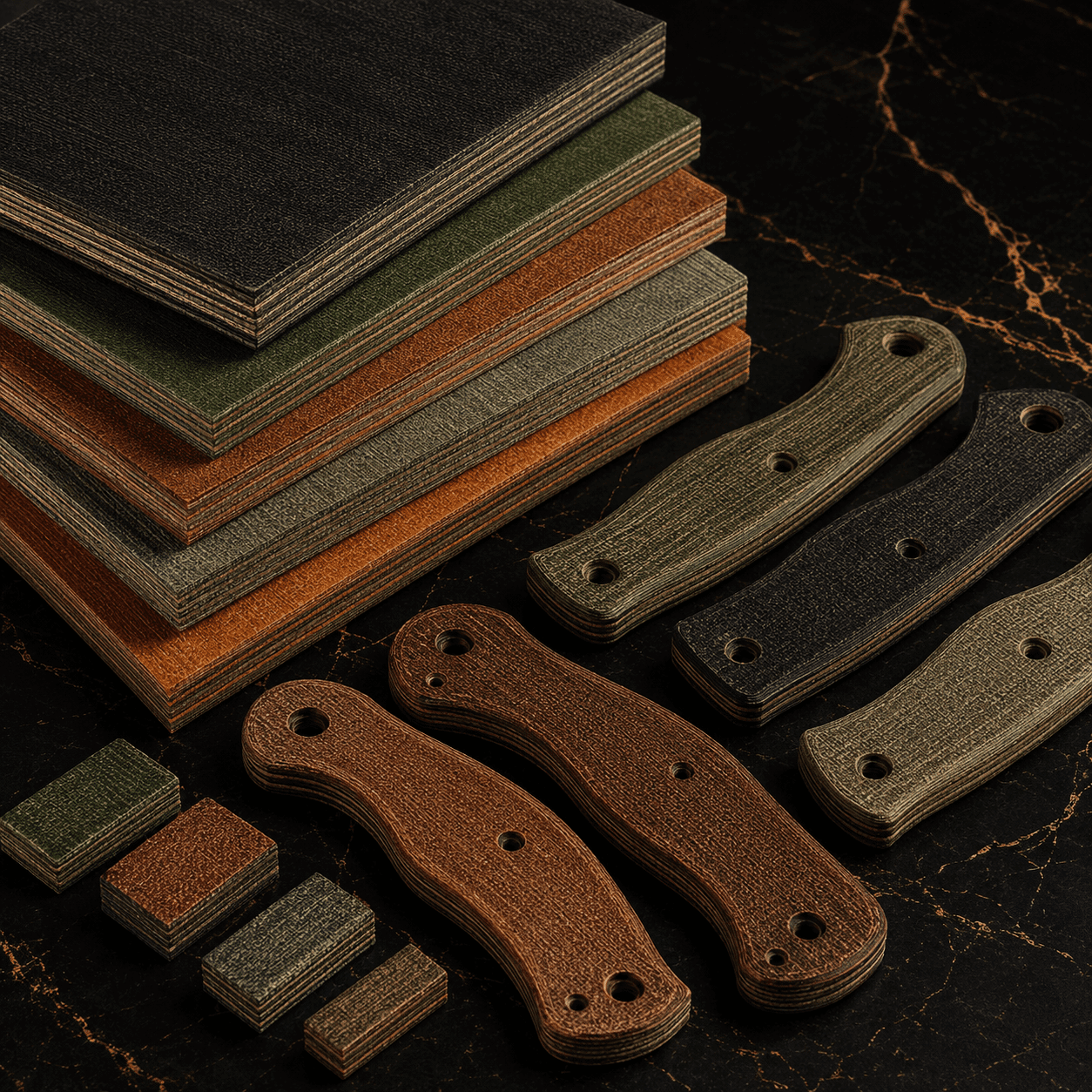
If you spend any time shopping for a quality knife, you will face this question: G10 or Micarta? These two materials dominate the world of synthetic knife handles. They are made using similar processes, they cost roughly the same, and they both outperform wood, bone, and most plastics by a wide margin.
But they are not the same. G10 and Micarta feel different in the hand, age differently over time, and perform differently in wet conditions. Choosing the wrong one for your use case can leave you with a handle that is too slippery, too heavy, or too industrial-looking for your preferences.
This guide compares G10 and Micarta across every metric that matters: strength, weight, grip, moisture resistance, aging, feel, maintenance, cost, and real-world performance. By the end, you will know exactly which material belongs on your next knife.
At a Glance: The Short Answer
G10Micarta
Best for All-round performance, hard use, wet environments Warm feel, character development, wet grip
Signature trait Indestructible consistency Patina that tells a story
Choose if you want A handle that never changes A handle that becomes yours
What They Are Made Of
G10
G10 is a fiberglass-epoxy laminate. Layers of woven fiberglass cloth are saturated with epoxy resin, stacked, and compressed under high heat (~150°C) and pressure. The result is a dense, rigid, non-porous composite with no internal voids.
The “G” stands for glass fiber reinforcement. The “10” refers to the specific NEMA performance grade. It was developed in the 1950s for electrical insulation and adopted by knife makers in the 1980s.
Micarta
Micarta is a fabric-phenolic laminate. Layers of linen, canvas, paper, or other fabric are saturated with phenolic (or sometimes epoxy) resin, then compressed under heat and pressure.
Micarta was invented by George Westinghouse around 1910 using phenolic resins from Leo Baekeland (the creator of Bakelite). It was originally an electrical insulator. The brand name is now owned by Norplex-Micarta, though the term is used generically for similar fabric-resin laminates.
The Core Difference
The key distinction is the reinforcement material:
G10 = fiberglass + epoxy resin → hard, industrial, color-stable
Micarta = fabric + phenolic resin → warm, organic, develops patina
Head-to-Head Property Comparison
Property G10 Micarta Winner
Density 1.80–1.85 g/cm³ 1.30–1.40 g/cm³ Micarta (lighter)
Tensile Strength ~40,000 psi ~12,500 psi G10
Flexural Strength 55,000–75,000 psi 25,000–35,000 psi G10
Rockwell M Hardness 110 ~105 G10 (marginal)
Moisture Absorption Near zero Low to moderate G10
Wet Grip Good (textured) Excellent (improves when wet) Micarta
Impact Resistance Excellent Very good G10
Thermal Insulation Good Very good (warmer feel) Micarta
UV Resistance Excellent—colorfast Moderate—darkens over time G10
Scratch Visibility Low—texture hides wear Moderate G10
Dimensional Stability Excellent Excellent Tie
Strength and Durability
G10 Is the Stronger Material
The numbers are clear. G10 has roughly 3 times the tensile strength of Micarta and more than 2 times the flexural strength. The fiberglass reinforcement creates a denser, harder composite that resists deformation under load.
In practical terms, this means:
A G10 handle is less likely to crack or chip from a hard drop.
G10 holds up better under extreme compression (e.g., if the knife is used as a hammer or pry tool).
The difference in hardness (110 vs 105 Rockwell M) is small but real—G10 resists surface wear slightly better.
Micarta Is No Slouch
Micarta’s tensile strength of 12,500+ psi is still far beyond what any reasonable knife use will demand. A Micarta handle will not fail under normal cutting, chopping, or carry conditions. The material has been used on military knives, survival tools, and hard-use fixed blades for decades without issue.
The practical takeaway: both are durable enough for any knife. G10 is stronger on paper, but the difference only matters under extreme abuse that most knives will never see.
Winner: G10, by a measurable but practically narrow margin.
Weight
Micarta Is Noticeably Lighter
At 1.30–1.40 g/cm³, Micarta is roughly 25% lighter than G10 (1.80–1.85 g/cm³). This difference is significant: a Micarta-handled knife feels lighter in the pocket and slightly more nimble in the hand.
For context:
A typical set of folding knife scales in G10 might weigh 20–25 grams.
The same knife in Micarta would weigh 15–19 grams.
Against metal handles, both are light—titanium scales of the same size weigh 50+ grams.
If weight is a priority, Micarta is the lighter option. That said, both materials are considered lightweight compared to metals.
Winner: Micarta.
Moisture Resistance
G10 Is Virtually Waterproof
G10’s fiberglass-epoxy structure has essentially zero porosity. Water cannot penetrate the material at all—not through the surface, not through the edges. A G10 handle left in water for days will emerge completely unchanged.
This is G10’s single biggest performance advantage over Micarta.
Micarta Absorbs Some Moisture
Micarta’s fabric fibers can absorb small amounts of water, particularly at cut edges where the fabric is exposed. The absorption is minimal—nowhere near what wood would take in—but it is real. Over repeated wet-dry cycles in extreme conditions, this could theoretically affect the material, though in practice, knife users rarely report problems.
The upside? Micarta’s slight moisture absorption is part of why it gets grippier when wet (see below).
Winner: G10, for absolute water resistance.
Grip
This is where the comparison gets interesting—and where Micarta has a unique edge.
Micarta Gets Grippier When Wet
Micarta has a property that almost no other knife handle material shares: its grip actually improves when wet. Two factors contribute:
The exposed fabric fibers at the surface swell slightly with moisture, increasing surface area and friction.
Phenolic resin itself exhibits increased surface friction when wet (a property shared with Bakelite).
The result: a Micarta handle that feels secure even when covered in water, fish slime, or blood. This is why hunting knives, fishing knives, and marine tools frequently use Micarta.
G10 Depends on Texturing
G10’s grip is entirely dependent on how the manufacturer finishes the surface:
Bead-blasted or machined G10 with cross-hatching, stippling, or grooves provides excellent grip in all conditions.
Smooth, polished G10 can feel slippery, especially when wet.
The material itself does not become grippier when wet—only surface texture provides traction. A well-textured G10 handle grips very well; a smooth one does not.
The Burlap Factor
Burlap Micarta deserves special mention. Its coarse, open weave creates the most aggressive texture of any Micarta variant. The grip is exceptional wet or dry, to the point where it can feel abrasive against bare skin or pocket fabric. For working knives used in wet conditions, burlap Micarta is the grip champion.
Winner: Micarta, for its unique wet-grip advantage. G10 can match it dry with proper texturing, but cannot match Micarta’s wet performance.
Feel and Comfort
Micarta Feels Warm and Organic
Micarta’s fabric substrate gives it a tactile warmth that synthetics cannot replicate. The natural fibers transfer heat differently than glass, so the handle warms quickly to body temperature. It feels less “plastic” and more like a natural material—somewhere between wood and dense rubber.
In cold weather, this matters. A Micarta handle will not feel freezing against bare skin the way metal handles do, and it feels slightly warmer than G10.
G10 Feels Hard and Industrial
G10 is rigid and unforgiving. It has no “give” and no warmth. The texture is purely a surface treatment—the material underneath is uniformly hard. Some users find this comfortable and confidence-inspiring; others find it fatiguing during prolonged use.
G10’s hardness also means it transmits more vibration to the hand during chopping or batoning. Micarta’s fabric layers absorb some of that shock.
Winner: Micarta, for warmth and comfort. G10 users who prefer a harder, more rigid feel may disagree.
Aging and Appearance Over Time
This is the most subjective category—and arguably the most important for long-term satisfaction.
G10 Stays the Same Forever
G10 is colorfast and chemically stable. The pigment is mixed into the epoxy resin before curing, so the color runs through the entire thickness. Ten years of daily carry will not change a G10 handle’s appearance. No fading, no darkening, no patina. What you see on day one is what you will see on day 3,650.
This consistency is either G10’s greatest strength or its greatest weakness, depending on your preferences.
Micarta Develops Patina
Phenolic-resin Micarta darkens with UV exposure and absorbs oils from hands over time. The result is a patina—a gradual shift in color and a polished sheen at high-contact points:
OD green shifts toward brown.
Natural and ivory tones develop warm amber depth.
The surface polishes where the thumb rests and where the handle rubs against a pocket.
Exposed areas age while protected areas retain their original color.
Epoxy-resin Micarta (used in some modern production) stays more color-stable and will not develop the same dramatic patina.
Vintage Westinghouse Micarta (pre-1995) is famous for its aging character. Collectors pay premium prices specifically for the patina that only decades of use can create.
Winner: Depends on you. If you want a handle that never changes, choose G10. If you want a handle that develops character and becomes uniquely yours, choose Micarta.
Maintenance
G10: Wash and Forget
G10 requires essentially zero maintenance. Soap and water clean it completely. It does not absorb stains, oils, or odors. It does not need oiling, conditioning, or sealing. If it gets deeply scratched, light sanding restores the texture, and the color is consistent throughout.
Micarta: Clean but Do Not Oil
Micarta is also low-maintenance, but with a few more considerations:
Cleaning: Warm water, soap, and a soft brush remove grime. A Scotch-Brite pad handles stubborn dirt. Work in the direction of the fabric weave.
Do not oil: Micarta does not need oiling like wood. Oiling can fill the surface texture and reduce grip. However, some collectors apply a light coat of mineral oil to deepen the color on safe queens.
Patina is permanent: Once the resin has darkened from UV and aging, the only way to reverse it is to sand to fresh material—which permanently removes surface material.
Oil stains: Light oil staining can be drawn out with an ammonia-based cleaner like Windex. Let it dry, then wash with soap.
Winner: G10, for pure simplicity. Micarta is still low-maintenance compared to wood or leather, but G10 is the ultimate “do nothing” material.
Aesthetics and Color Options
G10: Wide Range, Industrial Look
G10 is available in dozens of solid colors and layered combinations. Black, OD green, coyote brown, gray, blue, red, orange, and bright neon colors are all standard. Layered G10 stacks different colored sheets so that machining reveals the underlying layers, creating visible stripes or patterns.
The look is distinctly synthetic and industrial. Even brightly colored G10 reads as “engineered” rather than natural.
Micarta: Natural Warmth, Fewer Options
Micarta’s color range is narrower. Natural, black, OD green, brown, and burgundy are common. Blue denim Micarta is a recent addition for those seeking something different.
The visual appeal comes not from bold colors but from the subtle fabric texture visible beneath the resin. Canvas Micarta shows a coarse weave. Linen Micarta has a fine, refined grain. Paper Micarta can be polished to an ivory-like finish. The material reads as “crafted” rather than “manufactured.”
Winner: G10 for color variety. Micarta for natural warmth.
Cost
Both materials occupy a similar price tier in the knife market. Neither is as cheap as FRN/Zytel, and neither is as expensive as carbon fiber or titanium.
G10 is the more affordable of the two. It is produced in larger volumes, and the raw material costs less. A G10-handled production knife typically carries a modest premium over an FRN version.
Micarta costs slightly more, particularly genuine Norplex-Micarta (as opposed to generic phenolic laminates). Linen Micarta is typically the most expensive variant. Custom knives with vintage Westinghouse Micarta carry significant premiums.
For most production knives, the price difference between G10 and Micarta versions of the same model is small—often $10–30.
Winner: G10, by a small margin.
Use Case Recommendations
Choose G10 If:
You want the strongest possible synthetic handle. For hard-use tactical, survival, or work knives that will face abuse, G10’s superior tensile and flexural strength provides an extra margin.
You work in consistently wet environments. G10’s zero moisture absorption means it will never swell, warp, or degrade from water exposure.
You want a handle that looks exactly the same in ten years. Colorfast and chemically stable, G10 does not age.
You value maximum grip through aggressive texturing. G10 holds machined textures extremely well.
You want the most color options. Dozens of solid colors and layered patterns are available.
You are on a tighter budget. G10 is typically the more affordable choice.
Choose Micarta If:
You want the best wet grip available. Micarta’s unique ability to become grippier when wet makes it ideal for hunting, fishing, and outdoor knives.
You prefer a warm, organic feel. Micarta’s fabric base feels closer to wood than plastic.
You value character and patina. A Micarta handle that has aged for years tells the story of its use.
You want the lightest rigid handle material. Micarta is approximately 25% lighter than G10.
Shock absorption matters for your use case. Fabric layers dampen vibration better than fiberglass.
You are a collector who appreciates tradition. Vintage Westinghouse Micarta has historical significance and premium value.
The Tiebreaker: Terrain and Conditions
Scenario Best Choice
Everyday carry in an office or city Either—pick based on feel and aesthetics
Wet, rainy, or marine environments G10 if waterproofing matters most; Micarta if wet grip matters most
Hunting and game processing Micarta (wet grip + blood/moisture performance)
Hard-use tactical or survival G10 (maximum strength)
Cold-weather carry Micarta (warmer feel)
Ultralight backpacking Micarta (lighter weight)
Safe queen or collector piece Micarta (aging character)
Maximum color customization G10
Conclusion
G10 and Micarta are both excellent knife handle materials. Neither is the wrong choice for most knives. The decision comes down to what you value.
Pick G10 if you want the strongest, most waterproof, most consistent handle material available. It is the set-it-and-forget-it option—a handle that will look and perform exactly the same after a decade of hard use.
Pick Micarta if you want a handle that feels alive, grips better when things get messy, and develops character that is uniquely yours. It is the choice for people who view their knife as a companion, not just a tool.
For many knife enthusiasts, the real answer is: own both. A G10-handled work knife for the wet and dirty jobs, and a Micarta-handled folder that ages beautifully in the pocket.