 YOUDA COMPOSITE
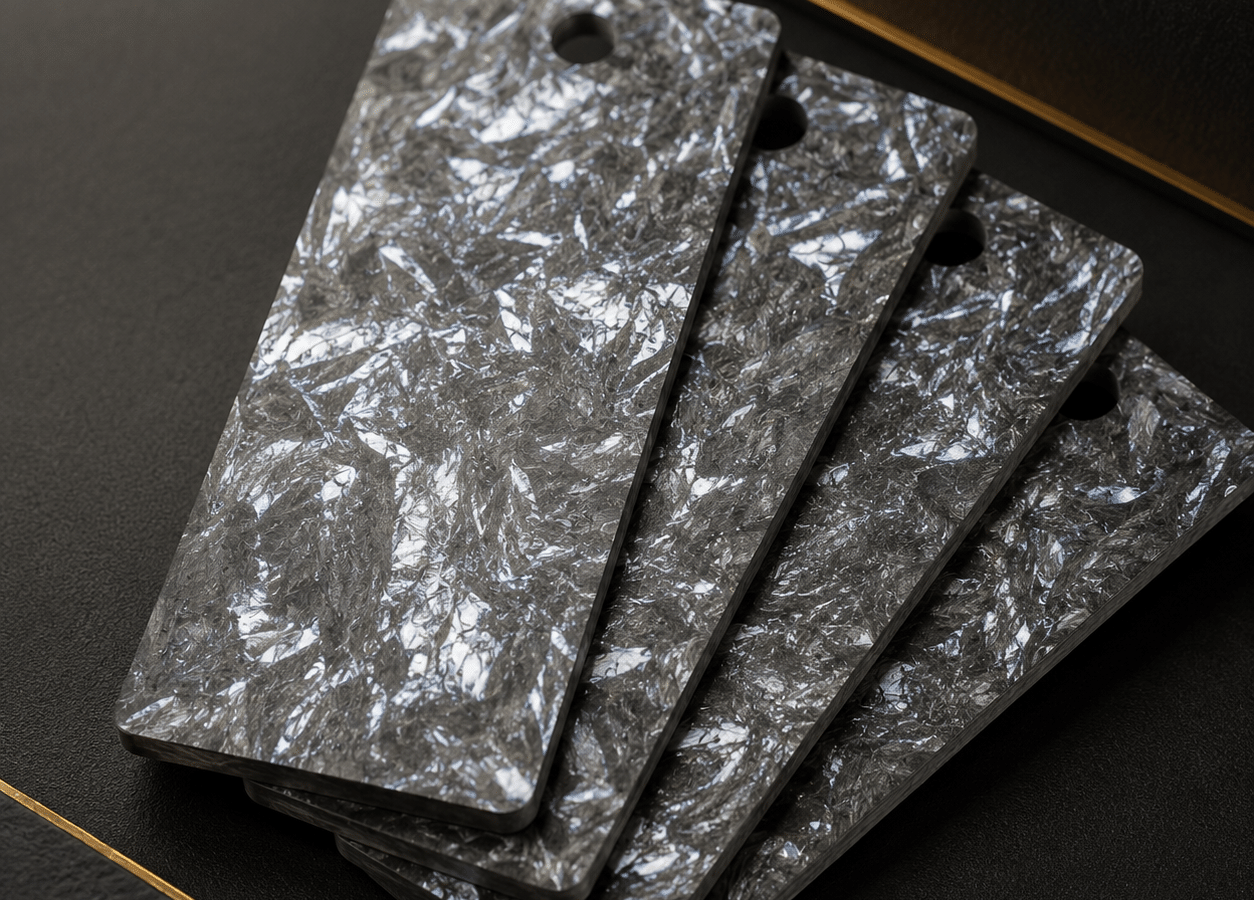
A carbon fiber knife handle is easy to spot. The distinctive woven pattern catches light differently from every angle, giving the material a three-dimensional depth that no other handle material can match. It is the lightest rigid handle option available, and it carries a premium price tag to match its premium look.
But carbon fiber is more than good looks. It has the highest strength-to-weight ratio of any material commonly used in knife handles. A carbon fiber scale can be half the weight of G10 while offering greater stiffness. For knife makers and enthusiasts who prioritize lightweight carry without sacrificing structural integrity, nothing else comes close.
This article explains what carbon fiber is, how it is made, the different types and weave patterns used in knife scales, and how it compares to other handle materials.
What Is Carbon Fiber?
Carbon fiber is a composite material made from extremely thin strands of carbon atoms—each fiber is just 5 to 10 microns in diameter, thinner than a human hair. Thousands of these filaments are bundled into “tows,” which are then woven into fabric. Layers of carbon fiber fabric are saturated with epoxy resin and cured under heat and pressure to form a rigid laminate.
The result is a material with remarkable properties: it is approximately five times stronger than steel and twice as stiff, yet weighs roughly one-fifth as much.
Note on terminology: When knife makers say “carbon fiber handle,” they are referring to carbon fiber reinforced polymer (CFRP)—carbon fiber fabric bonded with epoxy resin. Raw carbon fiber fabric is flexible and unusable as a handle until it is laminated.
How Carbon Fiber Is Made
The production of carbon fiber involves several demanding steps:
Precursor Production: About 90% of carbon fiber starts as polyacrylonitrile (PAN), a synthetic polymer. The remaining 10% comes from rayon or petroleum pitch.
Carbonization: The precursor fibers are heated to extremely high temperatures (1,000–3,000°C) in an oxygen-free environment. This drives off non-carbon atoms and aligns the remaining carbon atoms into a crystalline structure.
Surface Treatment: The fiber surfaces are oxidized to improve bonding with epoxy resin. This step is critical for the final composite’s strength.
Sizing: A protective polymer coating is applied so the fibers can be woven without damage.
Weaving: The carbon fibers are woven into fabric in various patterns—plain, twill, satin, or other configurations.
Lamination: Layers of carbon fiber fabric are stacked, saturated with epoxy resin, and cured under heat and pressure. The fiber orientation in each layer determines the final properties along each axis.
Key Properties of Carbon Fiber
Property | Carbon Fiber Laminate | G10 (for comparison) |
Density (g/cm³) | ~1.55 | 1.80–1.85 |
Tensile Strength | ~600 MPa (87,000 psi) | ~276 MPa (40,000 psi) |
Tensile Modulus | ~70 GPa (10 MSI) | ~20 GPa |
Flexural Strength | 80,000+ psi | 55,000–75,000 psi |
Moisture Absorption | Near zero | Near zero |
Thermal Expansion | <1 × 10⁻⁶ in/in/°F | ~5–8 × 10⁻⁶ in/in/°F |
Unmatched Strength-to-Weight Ratio
Carbon fiber’s standout property is its specific strength—strength divided by weight. A balanced carbon fiber laminate has a specific tensile strength approximately 5 times that of aluminum and 4 times that of steel. In plain terms: you get far more strength per gram than any other material.
Extreme Stiffness
Carbon fiber has a tensile modulus of about 70 GPa—roughly 3.5 times stiffer than G10. This means a carbon fiber handle will not flex or deform under loads that might cause other materials to give slightly. For knife handles, this translates to a rock-solid feel and precise dimensional stability.
Near-Zero Thermal Expansion
Carbon fiber expands and contracts with temperature changes at less than one-millionth of an inch per inch per degree Fahrenheit. For comparison, steel expands at roughly 7 times that rate, and aluminum at 13 times. A carbon fiber handle scale will maintain a perfect fit against the tang and liners regardless of whether the knife is in a frozen truck or a hot glove box.
Corrosion Resistance
Carbon fiber does not rust, corrode, or degrade when exposed to moisture, saltwater, or chemicals. It is fully inert in environments that would attack metals and natural materials.
Anisotropic Properties
Unlike metals, which have the same properties in all directions, carbon fiber is anisotropic—its strength runs along the axis of the fibers. This is not a weakness; it is a design feature. Knife makers orient the fiber layers to optimize strength where the handle needs it most.
Types of Carbon Fiber Used in Knife Scales
Not all carbon fiber looks or performs the same way. Here are the main types you will encounter in knife handles:
- Twill Weave Carbon Fiber
Twill weave is the most common carbon fiber pattern in knife handles. The fibers are woven in a diagonal pattern that creates a distinctive, visually appealing textured appearance. “3K twill” means each tow contains 3,000 individual carbon filaments.
Appearance: Classic diagonal weave with deep visual depth. Catches light in a way that shifts as the handle is rotated.
Performance: Balanced stiffness in both warp and weft directions. The most structurally predictable pattern.
Best for: Premium EDC knives, show pieces, and any application where the classic carbon fiber look is desired.
Cost: Standard for quality carbon fiber knife handles.
- Plain Weave Carbon Fiber
Plain weave uses a simple over-under pattern similar to a checkerboard. It is less common in knife handles than twill but offers good all-around properties.
Appearance: Tight, uniform grid pattern. Less visually dramatic than twill.
Performance: Excellent stability and equal properties in both directions.
Best for: Applications where maximum structural uniformity matters.
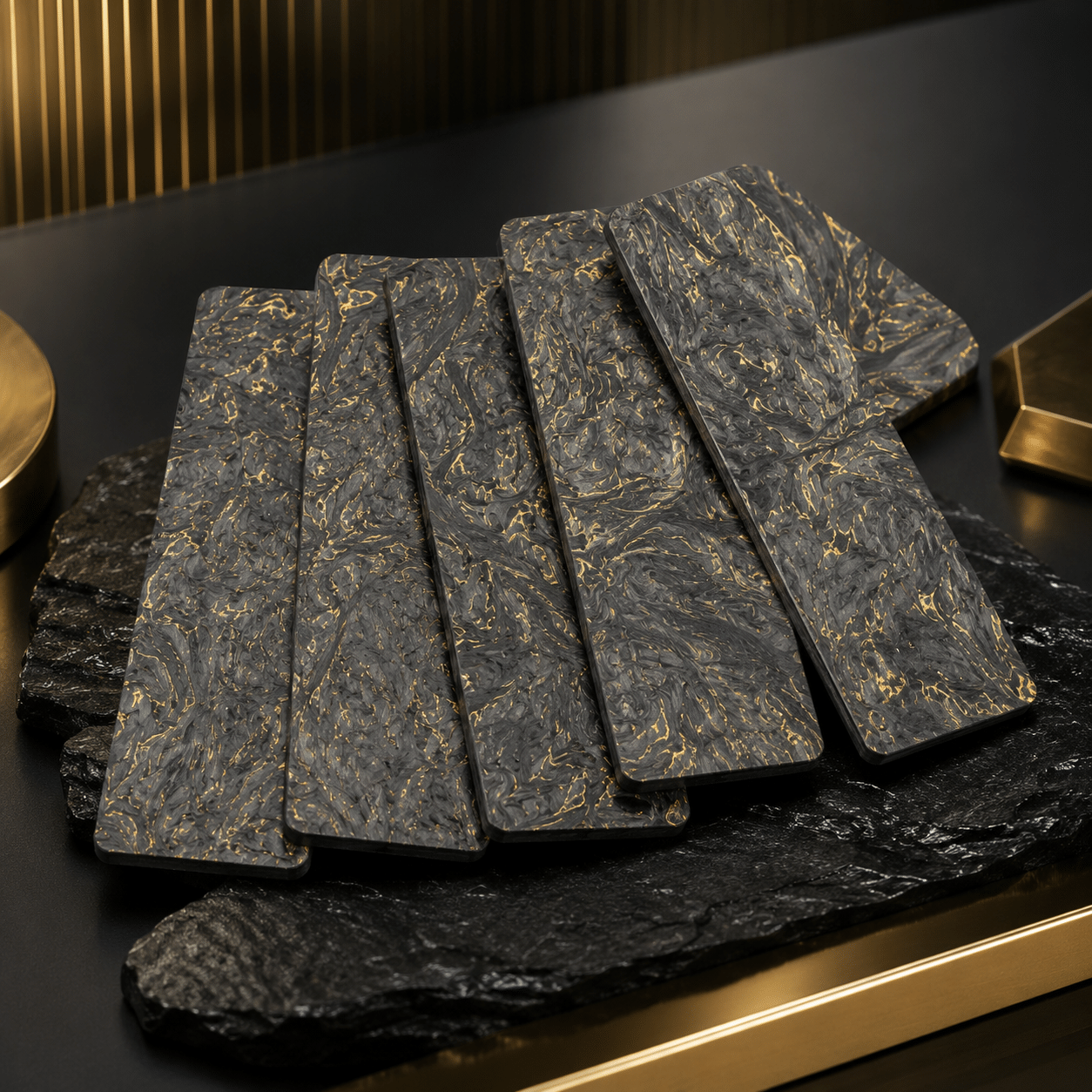
- Forged Carbon Fiber (Marbled Carbon Fiber)
Forged carbon fiber is made by placing short, randomly oriented carbon fiber strands into a mold with resin, then compressing under heat and pressure. The result looks nothing like traditional woven carbon fiber.
Appearance: Marbled, organic pattern with no visible weave. Each piece is completely unique.
Performance: Strength is uniform in all directions (unlike woven carbon fiber). Slightly lower peak strength than aligned fibers, but no weak axis.
Best for: Knives where a unique, non-traditional look is desired. Increasingly popular on custom and mid-tech knives.
Brand names: Fat Carbon “Dark Matter” is a well-known forged carbon fiber product.
- Shredded Carbon Fiber
Similar to forged carbon fiber but uses larger, more irregular fiber pieces. Often mixed with colored resins for visual effect.
Appearance: Chunkier, more textured marbled pattern.
Performance: Good overall properties, slightly below forged carbon fiber.
Best for: Budget-friendly carbon fiber options with unique aesthetics.
- Colored Carbon Fiber Hybrids
Modern manufacturers like Fat Carbon produce carbon fiber sheets with colored layers, metallic flakes, or hybrid fiber blends (carbon + copper wire, carbon + colored glass, etc.).
Appearance: Vibrant, unique—far beyond traditional black carbon fiber.
Performance: Similar to standard carbon fiber, with minor variations depending on the hybrid composition.
Best for: Custom and semi-custom knives where visual differentiation is the priority.
Carbon Fiber vs. G10
This is the most common comparison in the knife world, as both are high-performance composites.
Property | Carbon Fiber | G10 |
Density | ~1.55 g/cm³ | 1.80–1.85 g/cm³ |
Flexural Strength | 80,000+ psi | 55,000–75,000 psi |
Stiffness | ~3.5x stiffer | Standard |
Impact Resistance | Moderate—can crack or chip | Good—absorbs and disperses impact |
Wet Grip | Fair | Good (when textured) |
Cost | High to very high | Moderate |
Machining | Difficult—requires diamond tooling | Difficult—abrasive on tools |
Appearance | High-tech, premium | Industrial, wide color range |
When to Choose Carbon Fiber
Choose carbon fiber when:
Weight matters above all else. For ultralight EDC builds, carbon fiber saves grams that add up over a full day of carry.
Stiffness is a priority. Carbon fiber’s rigidity provides a feeling of absolute solidity.
Aesthetics are key. The three-dimensional woven look is unmistakably premium.
Budget allows. Carbon fiber adds significant cost to a knife.
When to Choose G10
Choose G10 when:
Impact resistance matters more than weight. G10 handles drops and impacts that could crack carbon fiber.
Budget is a concern. G10 offers similar practical performance at a much lower price.
Wet grip is important. Properly textured G10 provides better wet traction than smooth carbon fiber.
You need color variety. G10 comes in dozens of colors and layered patterns at accessible prices.
Carbon Fiber vs. Titanium
These are the two premium handle materials that often compete at the top end of the market.
Property | Carbon Fiber | Titanium |
Density | ~1.55 g/cm³ | ~4.51 g/cm³ |
Weight (relative) | 1x | ~2.9x heavier |
Stiffness | High | High |
Impact Resistance | Brittle—can crack | Excellent—may dent but will not crack |
Corrosion Resistance | Excellent | Excellent |
Anodizing | No | Yes—vibrant colors possible |
Scratch Resistance | Moderate | Shows scratches more readily |
Cost | High | High |
Temperature Feel | Warm | Warm (low thermal conductivity for a metal) |
Carbon fiber wins on weight. Titanium wins on toughness. The choice comes down to whether you prioritize grams or durability.
Benefits of Carbon Fiber Knife Handle Scales
- Lightest Rigid Handle Material
At approximately 1.55 g/cm³, carbon fiber is lighter than G10 (1.85), Micarta (1.35–1.40), and dramatically lighter than any metal. A carbon fiber-handled knife disappears in the pocket.
- Premium Aesthetic
No other material has the visual depth of woven carbon fiber. The way light plays across the twill pattern gives the handle a dynamic, three-dimensional quality that photographs well and looks even better in person.
- Absolute Stiffness
Carbon fiber does not flex under load. The handle feels monolithic—no give, no movement, no sense that the material is working. This inspires confidence in the knife’s structural integrity.
- Corrosion and Chemical Resistance
Carbon fiber is inert. It does not rust, corrode, or react to moisture, saltwater, oils, or cleaning chemicals. This makes it suitable for marine environments and harsh conditions.
- Dimensional Stability
Carbon fiber’s near-zero thermal expansion means the handle scales will never loosen, gap, or shift due to temperature changes. The fit stays perfect season after season.
Limitations of Carbon Fiber
Brittleness Under Sharp Impact
This is the most significant weakness of carbon fiber. While it is exceptionally strong under steady loads, it can crack or chip when subjected to sharp, concentrated impacts—like dropping the knife handle-first onto a hard edge. G10 and titanium handle these scenarios better.
High Cost
Carbon fiber is expensive to produce and expensive to machine. Knife makers must use diamond-tipped tools, and the material wears tooling quickly. These costs are passed on to the buyer. Expect to pay a significant premium over G10.
Can Be Slippery
Smooth carbon fiber offers less grip than textured G10 or Micarta, especially when wet. Some manufacturers add texture or inlays to address this, but a polished carbon fiber handle prioritizes looks over traction.
Limited Repair Options
If G10 gets deeply scratched, you can sand it down and the color will be the same underneath. If carbon fiber chips or cracks, there is no simple fix. The damage is structural and permanent.
Environmental Sensitivity During Manufacturing
Carbon fiber production is energy-intensive, and the material is not biodegradable. However, for the end user, this has no effect on the knife’s performance or longevity.
Common Applications
Ultralight EDC Knives
Carbon fiber is the go-to material for knives designed to be as light as possible. The Benchmade Bugout with carbon fiber scales is a famous example—the carbon fiber version shaves significant weight off an already lightweight design.
Premium Production Folders
High-end production knives from companies like Spyderco, Benchmade, and WE Knife frequently offer carbon fiber variants. These knives pair premium blade steels with equally premium handle materials.
Custom and Mid-Tech Knives
Custom knife makers use carbon fiber extensively for show pieces and high-end user knives. Forged carbon fiber and colored hybrids are especially popular in this segment, where each knife is expected to be visually unique.
Gentleman’s Folders
Carbon fiber’s refined appearance makes it a natural fit for dress knives and office-friendly EDC. A carbon fiber-handled gentleman’s folder looks appropriate in a business setting while still performing like a serious tool.
Kitchen Knives
Some high-end kitchen knives use carbon fiber handles. The material’s light weight, stiffness, and corrosion resistance are all desirable in a kitchen environment.
Care and Maintenance
Carbon fiber requires minimal maintenance, but there are important points to know:
Cleaning: Wipe with a damp cloth. For stubborn grime, use mild soap and water. The non-porous surface will not absorb stains or odors.
Avoid Drops: This is the main maintenance concern. Carbon fiber can chip or crack on hard impacts. Treat a carbon fiber-handled knife with more care than you would a G10 beater.
Do Not Sand: Unlike G10 or Micarta, sanding carbon fiber will damage the visible weave pattern. Scratches on carbon fiber are generally permanent.
UV Exposure: Prolonged direct sunlight can eventually yellow the epoxy resin, though this takes years of continuous exposure. For most users, this is not a practical concern.
Storage: Store in a sheath or case to protect the surface from accidental scratches and impacts.
Conclusion
Carbon fiber represents the performance ceiling for knife handle materials. It is lighter, stiffer, and stronger per gram than anything else on the market. The visual appeal is undeniable—a quality carbon fiber handle commands attention in a way that few other materials can.
But it is not the universal best choice. The brittleness under impact and the high cost are real trade-offs. For a knife that will be carried daily, dropped occasionally, and used hard, G10 or titanium may be the more practical option. For a knife where every gram counts, where aesthetics matter, and where the owner is willing to treat it with appropriate care—carbon fiber is unmatched.