 YOUDA COMPOSITE
Two photographs seemed to show two colors
“We approved olive green. These look brown.” The customer's message included a photograph of finished handle scales beside an earlier sample image. The difference looked obvious on the screen. A product launch was approaching, and the customer wanted to know whether the wrong material had been supplied.In this illustrative story, the supplier began by asking to compare the actual objects. The approved reference was a flat fabric laminate coupon. The new parts had curved surfaces and a different finish. The two photographs were taken in different rooms. None of those observations proved the delivery correct, but each could affect what the customer was seeing.“Please keep one finished pair exactly as it is,” the supplier said. “We should compare it before anyone oils or polishes it.” A quick cosmetic change might make a photograph more convincing while making the original condition impossible to review. The customer agreed to keep the sample, the finished pair, and an unprocessed offcut identifiable. The discussion could now examine material identity and appearance separately. If the batch was wrong, the evidence should show that. If processing or presentation had changed the appearance, the customer needed to understand that before approving the next order.

The name covered several different constructions
The order was checked against the retained reference. It specified a canvas style fabric phenolic material, not simply a green composite sheet. Paper, fine fabric, coarse fabric, and other reinforcement constructions do not present the same visual texture after shaping. The supplier asked the customer to verify the product reference and batch connection before discussing a finish change.Micarta is a registered trademark of Norplex Micarta, although the word is often used broadly in the knife community. A supply description should identify the actual manufacturer or generic construction accurately. Using the familiar name does not demonstrate branded origin, and it does not make all fabric resin laminates interchangeable. In this story, the important purchasing detail was the agreed construction and reference sample, with brand origin confirmed only where documented.The customer had also received G10 and carbon fiber options during development. The supplier brought those samples to the discussion to explain why one appearance approval could not be applied across all three categories. Glass cloth, fabric reinforcement, and carbon weave offer different visual starting points. Choosing among them involved the intended look, finished geometry, and application requirements. There was no need to declare one universally better. For the current olive handle, the immediate task remained narrower: determine whether the supplied fabric laminate matched the material that had actually been selected.
The surface changed what the eye received
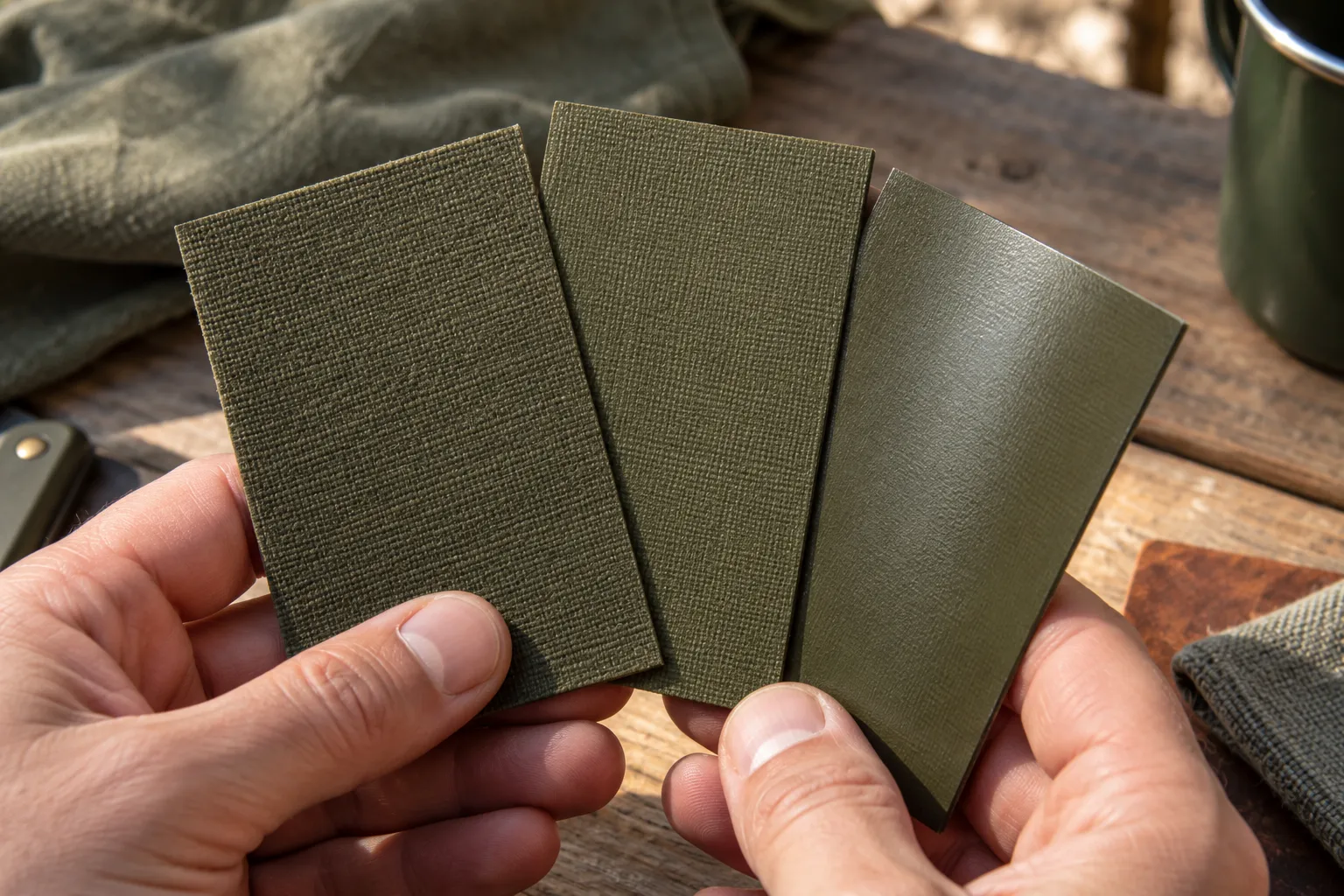
At the table, the customer placed the flat coupon beside a finished scale. The coupon had a relatively matte surface. The scale was smoother and curved toward the light. It reflected the room differently, and its visible fabric pattern was no longer presented in one flat plane. The supplier described these as possible contributors to the difference, not a complete explanation established in advance.Finishing can change how a composite surface scatters and reflects light. A film of liquid or a surface treatment can also change its immediate appearance. That does not mean every color complaint can be dismissed as a finish effect. Pigment, reinforcement, material identity, and batch differences still need consideration. The comparison had to keep those possibilities open.The customer admitted that the first reference photograph had been taken immediately after wiping the sample. Nobody had recorded whether it was fully dry. That made the picture a poor master reference, even though it had been useful for an early conversation. They decided to compare clean samples in an agreed dry condition before evaluating any intended surface treatment separately. The goal was not to force both objects to look alike. It was to understand which condition the customer expected the delivered handle to have and whether the proposed material and finishing route could reproduce it.
A fair comparison needed one viewing condition
The next comparison used the same table, background, and illumination. Both objects were viewed together, then rotated to see how the curved surface changed with angle. A neutral reference card helped describe the photographic setup. It was not presented as a calibrated color measurement or a substitute for an agreed inspection method.The customer asked whether a phone photograph could become the approval standard. The supplier explained the practical limitation: camera exposure, white balance, screen settings, and compression can change the result. A photograph can document a comparison, especially when samples appear in the same frame, but a screen image alone is a weak way to settle a close color dispute.If the project required numerical color control, the parties would need to agree the measuring method, reference condition, and acceptance limits appropriate to the actual textured component. They did not invent a universal color difference number for all fabric laminates. For this development stage, the customer preferred an identified physical reference made with the proposed final finish. That decision matched the way the product would be judged at launch. It also made the approval understandable to the processor: the target was a particular finished condition, not an old photograph that could look different on every person's phone.
The customer wanted a repeatable finished reference
A second question emerged: should approval cover the flat sheet or the completed handle? The supplier suggested retaining both, with different purposes. The stock reference helped connect a delivery to the selected material. The finished reference showed what the agreed shaping and surface treatment were intended to produce. One could not automatically replace the other.The processor prepared a proposed reference using documented operations. Any finish applied to the material had to be suitable for the product's intended use and handled according to its own instructions. An improvised oil treatment was not used merely to darken the sample for approval. Where a treatment affected grip, maintenance, or customer expectations, the product owner needed to consider those consequences as well as appearance.The customer also wanted paired scales to be reviewed together. A handle has two visible sides, and separately acceptable pieces may still form a visually disappointing pair. Pairing expectations therefore belonged in the purchase discussion. The supplier avoided promising perfect uniformity from a patterned material. Instead, the parties discussed what variation could be accepted and when a fresh approval would be needed. The result was a reference that a customer could actually recognize at delivery, supported by a description of how that reference had been made.
A later change would reopen the conversation
Before the next order, the customer considered changing the final sanding stage to reduce production time. Previously, that might have been treated as a workshop detail. Now he recognized that the visible and tactile result could change, even with the same stock material. The proposed process needed a representative finished sample for review.The same principle applied to a different fabric construction, a new surface treatment, or a change of material category. Moving from fabric phenolic to G10 or carbon fiber would create a new appearance discussion and could require broader design review. Similar nominal thickness did not make the finished effects equivalent. The supplier could present options, but the customer would approve the intended outcome against the product's requirements.They also improved the way a future complaint would be reported. The customer would identify the order and batch, provide the physical reference, and explain whether the questioned parts had been cleaned, treated, or handled before photography. Images would show the reference and questioned sample together where possible. This did not move responsibility away from the supplier. It made the evidence more useful to both sides. A real mismatch could be investigated sooner, and a change caused by processing would be less likely to be mistaken for a different material delivered in the box.

The useful promise was a clear approval basis
The story does not end with a claim that every batch will look identical. It ends with a clearer agreement about what the customer is buying and what the finished handle should look like. The original complaint was reasonable; the first comparison simply did not contain enough shared conditions to answer it.For a customer choosing fabric handle material, the most useful sample request includes the desired construction, color family, finished contour, and intended surface condition. If the launch depends on a particular appearance, ask for a reference that represents that finished state. Keep the sample identifiable and agree how future deliveries will be compared with it. A color name alone leaves too much room for different expectations.Our G10, fabric laminate, and carbon fiber discussions can begin with a sample image, but they become more productive when the actual component and approval conditions are included. Bring the finished reference, tell us what seems different, and say what has already been done to the surface. That gives the conversation a practical direction. The aim is a material and process combination that the customer can assess with confidence, with natural variation and unacceptable mismatch described clearly enough to support a fair decision.