 YOUDA COMPOSITE
Introduction
A knife handle must do more than look attractive. It has to remain stable in changing weather, provide secure control, tolerate repeated use, and support accurate machining. Solid color G10 meets these requirements with a clean appearance that works across outdoor knives, tactical knives, kitchen knives, folders, and production models.
Made by combining woven glass fiber fabric with thermosetting resin under heat and pressure, G10 forms a dense composite laminate. Unlike natural handle materials, it does not depend on grain direction or naturally occurring pores. This gives knife manufacturers a predictable material that can be cut, drilled, textured, and finished with consistent results.
What Is Solid Color G10?
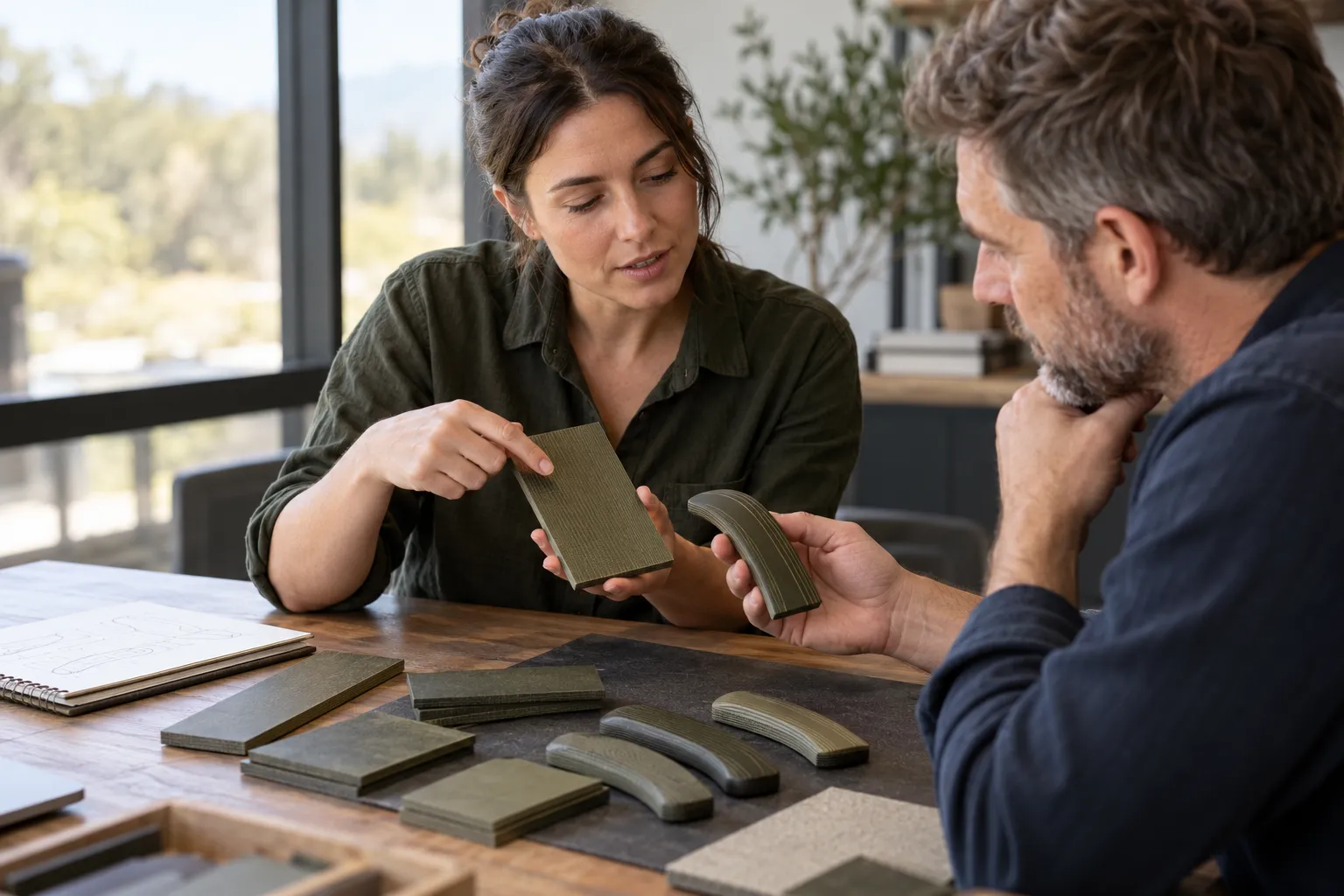
Solid color G10 is a glass-fiber-reinforced laminate manufactured with a uniform base color through the sheet. Common choices include black, olive green, natural, orange, red, blue, tan, and white. The exact shade and surface appearance depend on the resin system, glass cloth, sheet thickness, and finishing method.
The term “solid color” describes the overall visual design. Fine glass-fabric structure may still become visible after sanding or polishing, especially at edges or under strong light. It should not be interpreted as a molded plastic with no internal reinforcement. That reinforced structure is precisely what gives G10 its mechanical stability.
Why Solid Color G10 Works Well for Knife Handles
High strength with controlled weight. G10 provides a strong, rigid handle platform without the weight of many metals. It supports thin scales, full-tang handles, liners, backspacers, and other components where dimensional control matters.
Resistance to moisture and weather. Properly manufactured G10 has very low water absorption compared with wood and many fiber-based handle materials. It does not need oiling to maintain its basic stability, making it suitable for humid workshops, outdoor use, marine environments, and knives that may be washed frequently.
Reliable grip options. The surface can be left smooth, bead-blasted, sanded, checkered, grooved, or CNC-textured. Makers can choose a comfortable finish for everyday use or a more aggressive pattern for work gloves, wet conditions, and outdoor applications.
Good dimensional consistency. Uniform industrial sheets make thickness selection and repeat machining easier. This is especially useful when producing matching left and right scales or repeating the same handle design across a production batch.
Clean, versatile appearance. Solid colors keep attention on the knife profile, blade finish, fasteners, and contours. Black and olive green suit understated tactical designs, natural and tan give a technical neutral look, while orange or red can improve visibility in outdoor settings.
Advantages for Knife Manufacturers and Custom Makers
For manufacturers, repeatability is one of the strongest reasons to use solid color G10. A controlled sheet specification makes it easier to program CNC operations, standardize sanding stages, and maintain a consistent appearance from one batch to the next. The material also accepts precise holes, slots, contours, and surface patterns when correct composite-cutting tools and parameters are used.
For custom makers, solid color G10 is a flexible design base. It can be combined with contrasting liners, pins, tubes, bolsters, or spacers without creating visual conflict. A simple color also makes sculpted contours and hand-shaped details easier to see. The same sheet can produce a restrained matte handle or a more refined polished edge, depending on the intended style.
G10 also supports practical inventory planning. Standard colors can be used across several knife models, reducing the need to stock a separate decorative material for every design. This is useful for workshops that want variety through machining and hardware while keeping raw-material selection manageable.
Grip, Surface Texture, and Finishing Choices
Grip does not come from the material name alone. It is created by the combination of handle geometry, surface texture, contour, and finishing grit. A deeply machined pattern can provide strong traction, while a fine sanded finish is more comfortable for long periods of bare-hand use. Rounded edges reduce pressure points, and localized texture can add control without making the entire handle abrasive.
A polished G10 surface may look smooth and saturated in color, but it can become less secure when wet. For working knives, a controlled matte or textured finish is often more practical. Knife makers should prototype the final geometry and finish rather than judging grip from a flat raw sheet.
Machining and Workshop Safety
G10 machines cleanly, but its glass reinforcement is abrasive. Carbide tooling is generally preferred for repeat production, and worn tools can cause heat, edge damage, or an inconsistent finish. Stable clamping, suitable cutting speeds, dust extraction, and gradual finishing help protect both the part and the tool.
Cutting and sanding G10 produces fine glass-and-resin dust. Workshops should use effective local extraction, appropriate respiratory protection, eye protection, gloves when suitable, and cleaning methods that do not redistribute dust into the air. Safety practices should follow the supplier’s safety data and the workshop’s applicable occupational requirements.
How to Select Solid Color G10
Start with the finished handle dimensions, not only the raw sheet size. Allow enough thickness for flattening, contouring, texture depth, and final sanding. Confirm the required color using a physical sample whenever shade matching is important, because screen colors, lighting, resin batches, and surface finish can all affect appearance.
For production orders, specify sheet dimensions, thickness tolerance, flatness expectations, color, surface condition, required quantity, and whether cutting or CNC machining is needed. It is also useful to provide a drawing or finished-part model so the material layout and machining allowance can be reviewed before production.
Knife manufacturers looking for solid color G10 sheets, scales, or machined blanks can review available composite handle material options at https://ydcomposites.com/. Final specifications should always be confirmed for the intended knife design and processing method.
Frequently Asked Questions
Is solid color G10 suitable for outdoor knives? Yes. Its low moisture absorption, dimensional stability, and ability to accept high-grip textures make it a strong option for outdoor and working knives.
Does G10 require oiling like wood? No routine oiling is required to maintain the laminate itself. Normal cleaning and inspection are usually sufficient, although the complete knife should be cared for according to its blade, hardware, and construction.
Can solid G10 be polished? Yes. It can be finished from matte to polished. The best finish depends on whether grip, comfort, or visual depth is the priority.
Are all sheets of the same color identical? Industrial production offers good consistency, but reasonable batch-to-batch shade variation can occur. A confirmed sample and batch control are recommended for color-critical orders.
Can G10 be supplied as finished scales? It may be supplied as full sheets, cut pieces, paired scales, blanks, or CNC-machined components depending on the drawing, tolerances, and quantity.
Conclusion
Solid color G10 combines practical strength, moisture resistance, machining flexibility, and a clean visual language. It is suitable for both high-volume knife production and custom work because it gives designers a stable base that can be shaped, textured, and paired with many blade and hardware styles.
The best results come from choosing the right thickness, testing the final grip pattern, controlling machining dust, and confirming color expectations before batch production. When those details are managed, solid color G10 can deliver a durable and repeatable handle without unnecessary maintenance.